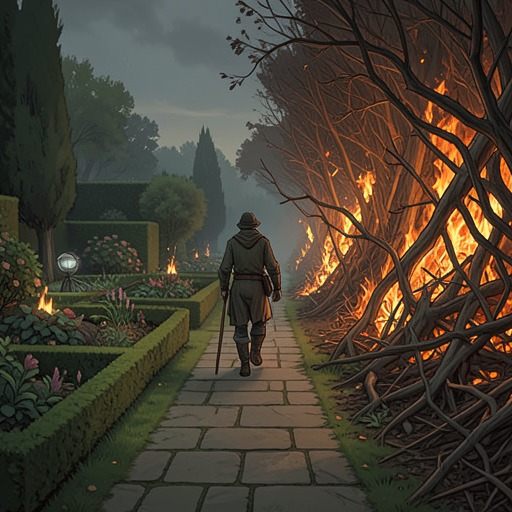
The middle way is best
Metamorphoses (Ovid Edition)“The middle way is best” is the governing principle of the advice given to Phaethon before he attempts to drive the Sun chariot. The expression turns a practical instruction about steering into a broader rule of conduct: survival and order depend on resisting extremes, holding a balanced course, and exercising judgment rather than surrendering to speed, impulse, or Fortune.
Definition and Immediate Context
The expression appears in a speech devoted to moderating the force of the horses. The coursers are naturally too swift, so Phaethon’s art must be to restrain their haste rather than intensify it. The danger does not arise from insufficient power; it arises from power that exceeds the driver’s control. Moderation is therefore presented not as weakness but as the skill required to govern an overwhelming force.
The advice is framed as instruction from an experienced guide to an inexperienced driver. Phaethon is told not to drive directly through the skies, but to follow the winding circle of the Zodiac. The route is neither an arbitrary line nor a heroic shortcut: it is a defined middle course within the ordered structure of the heavens. The expression names the central rule that makes the rest of the directions intelligible.
The Geography of Balance
The middle way is given a precise celestial location. Phaethon must keep along the “midmost Zone,” avoiding both the distant south and the stormy north. The command establishes balance through paired exclusions. The correct path exists between two dangers, and each extreme threatens the stability of the whole journey.
The horses’ hoofprints will mark a beaten track, but even that visible guidance is not enough by itself. Phaethon must neither mount too high nor sink too low. Vertical error carries consequences for both Heaven and Earth, since a deviation could cause new fires to infest either realm. The expression therefore links personal self-command with cosmic safety: the driver’s failure to maintain the middle course would become a catastrophe affecting the entire world.
The imagery makes equilibrium dynamic rather than static. The route winds through the Zodiac, while the horses rush forward and the driver must continually moderate them. Balance is not a position reached once and then preserved automatically; it is an active correction performed amid motion. The middle way requires vigilance precisely because the chariot is already moving too fast.
Avoiding Both Extremes
The counsel concludes by extending the rule beyond the specifically mapped route. Phaethon is warned away from the region where the serpent twines and from the place where the altar shines. These landmarks define further boundaries within the heavens, but the essential instruction remains negative and comprehensive: “Shun both extreams.” The driver must recognize limits on either side instead of treating one extreme as safe merely because it lies opposite the other.
At the same time, the advice does not promise total mastery. After Phaethon has kept to the central course and avoided the forbidden extremes, “the rest” is left to Fortune. This qualification gives the expression a measured realism. Prudence can reduce danger, but it cannot abolish contingency. The middle way is the best course available, not a guarantee that every consequence can be controlled by human effort.
The guide also tells Phaethon that this balance will serve him better than he can provide for himself. The line underscores the gap between confidence and competence. Phaethon possesses the desire to undertake the journey, but the wisdom needed to survive it must come through discipline and instruction. The maxim is thus both navigational advice and a warning against self-reliance unsupported by judgment.
Rhetorical and Thematic Significance
The expression gains force from its placement within a sequence of imperatives. Phaethon is repeatedly told where not to go, how far not to deviate, and what dangers lie beyond the proper track. Against the horses’ haste, the speech sets moderation; against the southern and northern extremes, the midmost Zone; against excessive height and depth, a carefully sustained level. The repeated structure makes balance audible before the maxim states it directly.
Its logic is also paradoxical in a productive way. The driver of the Sun chariot appears to possess extraordinary power, yet success depends on refusing spectacular movement. The heroic act is not to force the horses onward but to restrain them; not to claim the whole sky but to remain within a narrow, beaten course. The expression therefore places competence in controlled limitation rather than in display.
“The middle way is best” functions as a compact rule for the relationship between human ambition and cosmic order. The skies are not an empty field for individual glory: they contain a winding Zodiac, marked boundaries, dangerous regions, and consequences that reach both Heaven and Earth. Phaethon’s task is to enter that order without imagining that boldness alone can replace obedience to its limits. The expression’s lasting significance lies in that contrast between motion and measure, power and restraint, aspiration and the discipline required to keep aspiration from becoming ruin.